These two cases provide excellent examples of the type of cause-and effect documentation that can be demonstrated with proper data collection and analysis. In some cases, the program can be ceased to confirm the efficiency of the treatment. However, once the problem is solved, many users are reluctant to remove the program and risk system deterioration and possible permit violation.
Several areas where bioaugmentation has proven to be beneficial are discussed below.
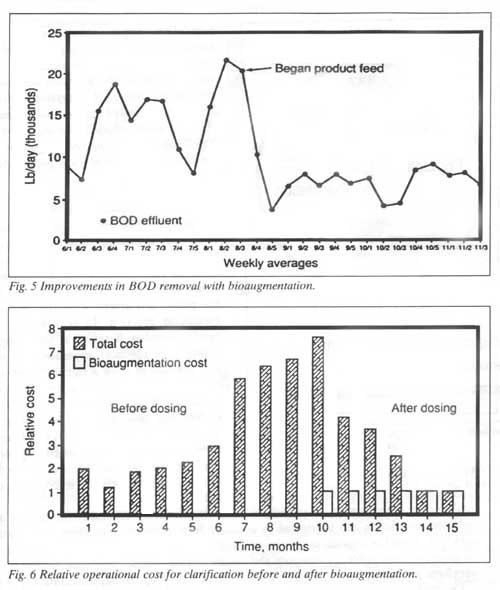
Enhanced BOD Removal — Many systems, particularly once-through aerated lagoons, are being asked to provide results for the 1990s with technology from the 1960s and 1970s. It would cost millions in capital to upgrade these systems. By increasing the microbiology numbers and diversity via bioaugmentation, the desired results can be achieved. In the pulp and paper industry in the southeastern United States, improvements in BOD effluent levels of 30 percent have been documented.
Improved Solids Settling — An important step in biological waste treatment is solids removal, usually through settling in a lagoon or clarifier. Bacteria form a natural biopolymer that aid in settling. Toxic shocks and system changes can result in a bacterial population with little biopolymer and poor settling characteristics. The traditional approach of adding organic polymers or inorganic coagulants as settling aids can be effective but expensive. By inoculating the system with organisms known to be both resistant to the toxicity and excellent floc formers, polymer demand can be greatly reduced or eliminated.
Typically, the cost of bioaugmentation is significantly less than polymer treatment. In addition, it provides an overall healthier biomass.
Improved Nitrification — Many industrial waste plants have difficulty in achieving nitrification because of design limitations or toxic shocks. By regularly adding nitrifying bacteria, the proper population for ammonia removal can be maintained.
Other areas — Other areas where bioaugmentation offers benefits include odor reduction, oil and grease removal, rapid system start-up and improved tolerance to toxic shocks. Additionally, research continues to explore new application areas for this evolving technology.
Summary
As environmental restrictions tighten, many industrial operators will be faced with compliance levels that will seriously challenge the capabilities of their existing wastewater treatment plants. In some cases, bioaugmentation will be a cost-effective, short-term or medium-term fix to keep them in compliance until system changes can be implemented. In other instances bioaugmentation will be the long-term solution because of the lack of capital funds or expense of the mechanical solutions.
The concept of effectively managing the microbiological population of an aeration basin is a new one. It involves much more than introducing new organisms into the system. Total system management requires in-depth understanding of waste plant operation and design, in addition to environmental microbiology. By combining these two disciplines effectively, the wastewater manager can be provided with the optimum results for the existing system.
Reprinted from Environmental Protection, October 1992