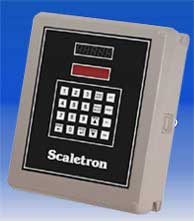
| MODEL 1099™ CHEMICAL PROCESS CONTROLLER | ||
|
||
|
MENU OPTIONS:
|
||
|
The Scaletron™ Model 1099™ Chemical Process Controller is central to the Scaletron Industries, Ltd. “Total Electronic System” which provides more accurate scale weights and automated use reports of chemicals used in the treatment of municipal drinking and industrial water, as well as municipal and industrial wastewater treatment. The Model 1099™ used in conjunction with Scaletron's electronic base scales will reduce or eliminate most of the problems associated with the use of water and wastewater treatment chemicals such as: under dosing, over dosing, need for round-the-clock monitoring, accurate record keeping requirements, worker safety, environmental concerns, and equipment deterioration due to a highly corrosive environment. The Model 1099™ Chemical Process Controller provides an automated way of controlling the batching process of chemicals used to prepare day-tanks, such as pumping several chemicals into a tank mounted on a scale base and mixing them together prior to dosing the desired chemical solution into the water system. Our Model 1099™ can operate 4 scales with 4 individual channels. It will monitor up to 4 groups of scales with each group using one channel for a total of 16 load cells. It is also capable of operating different types of scales (dual cylinder, drum, platform, ton) used in the same system provided that the number of load cells does not exceed 16. The Model 1099™ comes standard with one loop powered 4-20 mA circuit for channel #1. Three additional circuits are available for channels #2 thru #4. A maximum of four set points can be assigned among the four channels. The Model 1099™ will send all reporting information to a printer, recorder, or scada system and can provide permanent records of daily usage, amount used, days till empty, and the feed rate of four different scale bases, thereby preventing the system from running out of chemicals when the plant is unmanned. Set-point relays to control transfer and metering pumps can prevent over filling or under filling of day tanks. The unit can automatically regulate chemicals going into a tank, which is generally a safer and more accurate mode of operation. This reduces worker exposure and possible contact with chemicals. |